
I have noticed a trend that has gone on for far to long. A 12AX7 being used to drive a spring reverb. When Leo Fender first started putting reverb into his amplifiers, he used the best available tube for the job, the 12AT7. Most people know this tube as a lower gain version of the 12AX7, but it’s actually quite an amazing tube!
The 12AX7 gets all the recognition as the king of gain. It was designed to take a small signal, and make it MUCH MUCH larger. It is reasonably linear when used with small signals. When the signals get to big, it starts to sing in a way that has driven rock and roll to new heights! This is where a 12AX7 is happy, taking in the signal from a guitar, and passing a bigger version to the next tube in the amplifier.
The 12AT7 is often thought of as the weaker brother to the 12AX7. Many will put this in their amplifier to reduce the gain and add more clean headroom. This is not the ideal role for the 12AT7. This is kind of like replacing a sports car with a semi-truck for your daily driver, to avoid speeding tickets. It will work, but this is not what a 12AT7 is designed for.
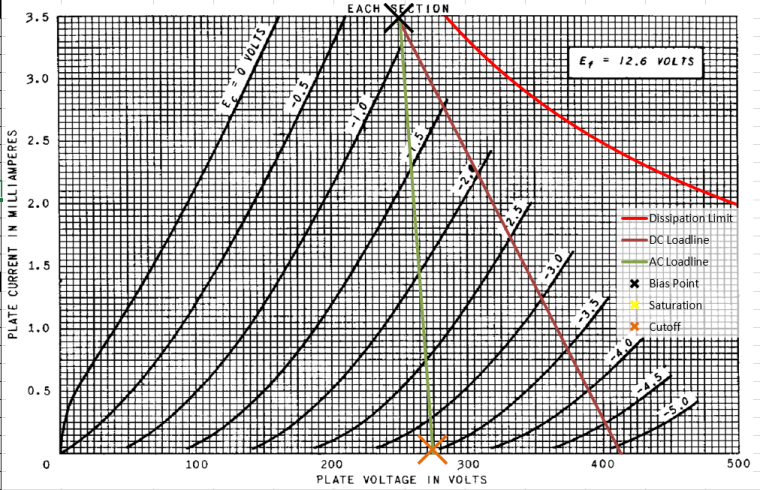
Below, I have a couple of graphs to show you what I mean. The graphs were taken from the original tube datasheets. The first one is from the 12AX7, and the second is from the 12AT7. I have overlaid them with the operating parameters for a Carvin tube reverb driver. The reverb that Carvin uses is 8,333 ohms. The green line represents the maximum non-distorted output signal that the tube is capable of, into this load. In the case of the 12AX7, it puts out a signal of 46 volts. It will swing from about 230 volts (way off the charts) to 276 volts (at the bottom). The current output will go from 0 to about 5.5 mA (way off the charts). The total power into the reverb is 250 milliwatts. This is clearly not the load that the inventors of the 12AX7 had in mind. The Fender reverb is closer to 22,000 ohms. This is better, but still not great. The line is slightly more slanted to the left.
In this second graph, I overlaid the same circuit on the datasheet for a 12AT7. This time, the green line swings from 116 volts to 188 volts for a total output of 72 volts. The current swings from 0 mA to 10.24 mA. It cannot exceed the Ec = 0 VOLTS line, and it cannot go below 0 mA of current. The total power into the spring reverb is 740 milliwatts. Nearly 3 times as much power! This is with only changing the tube. With additional resistor changes, the power output could double again!

The 12AX7 is a great tube, but using it to drive a reverb tank is like pulling a camper behind a sports car. Let’s give the 12AT7 the respect it deserves!
 JDP Amplifiers